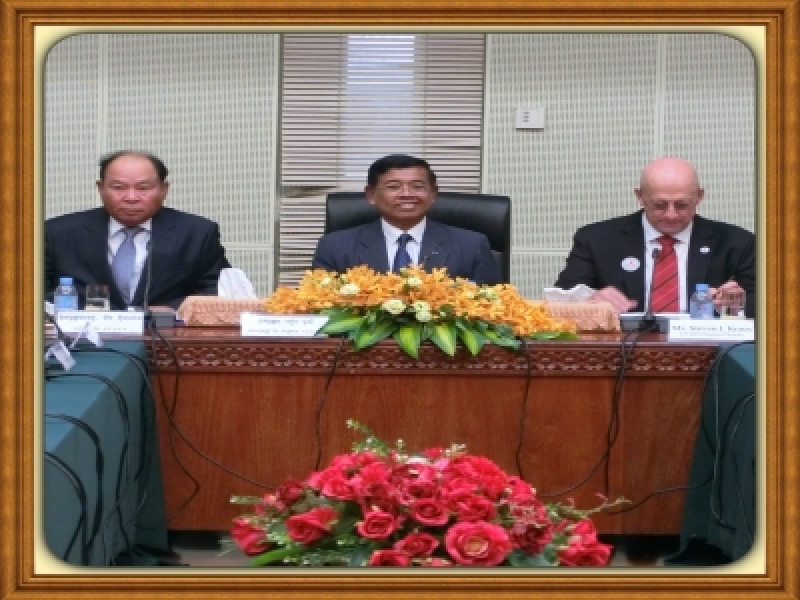
His Excellency Senior Minister Ieng Mouly Presides Over and Lead National AIDS Authority’s Plenary Meeting
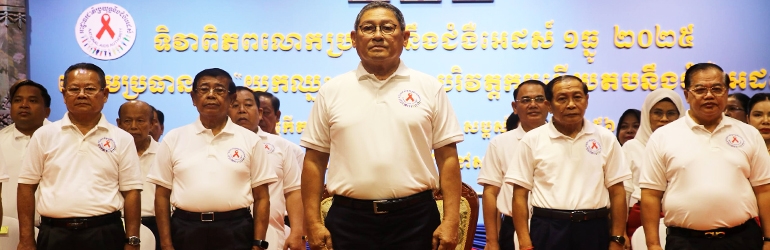
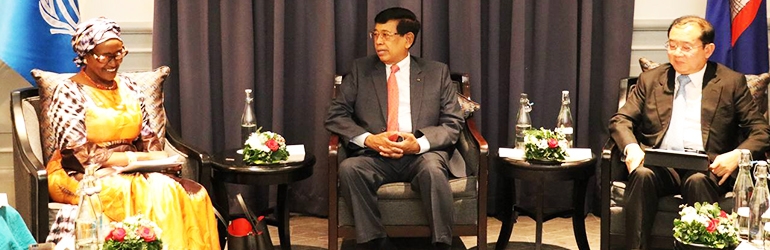
On the morning of November23, at the Office of the Council of Ministers, the National AIDS Authority opened its plenary meeting under the presidency of His Excellency Ieng Mouly, Senior Minister in charge of special mission and Chair of the National AIDS Authority. In keeping with the gist of the Law on Prevention and Control of HIV/AIDS Epidemic, the National AIDS Authority holds the plenary meeting once every six months to listen to and jointly assess the progress of the tasks carried out by the National AIDS Authority, the Ministry of Health, ministries, entities, territorial authorities, and development partners in the prevention of HIV infections. The meeting also discusses and looks for solutions to diverse challenges occurring over the last six months and sets targets to fight AIDS in the time ahead. Attending the National AIDS Authority’s 2nd plenary meeting 2016 were Their Excellencies, Lok Chumteav, ladies, and gentlemen, chairs of the AIDS committees at institutions, ministries, and subnational administrations, who represented legislative organizations, ministries, entities of the Royal Government, territorial administrations, the capital city, and provinces. Also participating in the meeting were Their Excellencies, Lok Chumteav, ladies, and gentlemen, heads of AIDS committee secretariats, as well as ladies and gentlemen representing development partners and aid donors. And especially, Steve Kraus, Director of UNAIDS for the Asia-Pacific region, was also present at the meeting. In conclusion, the meeting adopted a resolution whose key points are as follows: 1. Continue to implement the seven-point policy of the Royal Government, specified in letter No. 2048 sar chor nar dated 17 December 2013; 2. Continue to promote the dissemination of information on the 100% condom use to concerned ministries, entities, territorial authorities, the private sector, civil society, and the citizens facing HIV epidemic; 3. Boost partnership cooperation with community partners to increase the use of services among the citizens facing HIV infections; 4. Request cooperation in compiling and implementing the principle of global vigilance against HIV transmission; 5. Continue to strengthen and promote education on knowledge and publication of news about HIV transmission prevention to the public, especially to the youth, and 6. Enhance cooperation, participation, partnership, and coordination to bolster the principle: Early Blood Test, Early Treatment Towards Ending AIDS.







 info@naaa.gov.kh
 +855 (0)23 885 129
 +855 (0)23 885 279
 ភាសាខ្មែរ
 English