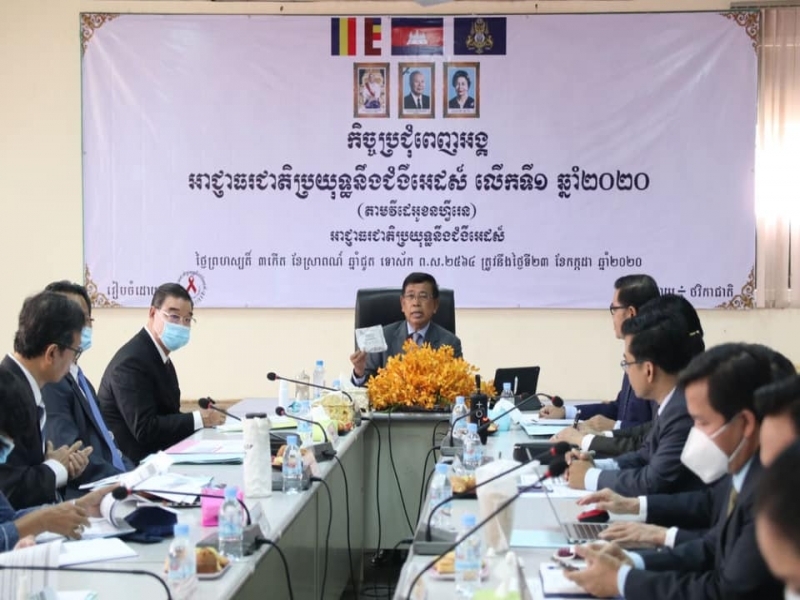
Points of Discussion at National AIDS Authority’s First Plenary Video-Conference Meeting 2020 National AIDS Authority, July 23, 2020
The meeting was held to jointly review the progress, achievements, and efficiency in the fight against AIDS over the first six months of 2020. In the wake of the Second Plenary Meeting 2019, scores of key events took place, including mainly:
1)The progress in the achievement of the 95-95-95 targets: In its July 2020 report, the UNAIDS announced that Cambodia has achieved to the targets of fighting AIDS at the 84-100-96 level. The figure has confirmed that we have already achieved the second and third 95 targets. This result has stemmed from the efforts exerted by all of us, with high sense of responsibility, in collaboration with the stakeholders concerned in the national AIDS fighting movement conducted under the high guidance of Samdech Akka Moha Sena Padei Techo Hun Sen.
2)With respect to the COVID-19 pandemic, the UNAIDS and World Health Organization (WHO) forecast that if there were delay in providing antiretroviral medication six months, there would be 534,000 more deaths in the Sub-Saharan region between 2020 and 2021. In our country, the supply of medicine and equipment is not that critical as in some Saharan countries. Nonetheless, direct education has been put off several months because of the closing down of entertainment karaoke venues and the descent into poverty of HIV carriers and key population. In this situation, we have diverted $316,000 from the Global Fund project to purchase COVID-19 infection prevention kits and we have extended the antiretroviral supply program many months to obviate the COVID-19 infection risk, utilizing the Global Fund’s $520,604 for Cambodia. Moreover, HIV carriers’ families, with Poor-ID cards, have received cash subsidy from the Royal Government within the project of reducing COVID-19 impacts as well.
3)The 23rd Virtual International AIDS Conference took place in San Francisco from July 6 to 10, 2020, where there are some good points which we should be interested in, such as:
1. Global resolve to prevent COVID-19 effects from harrying and reducing the will to end the AIDS epidemic by 2030.
2. Step up intervention to address inequality and diverse discriminations that are risk to AIDS prevention and care.
3. Some key scientific discoveries can be used to scale up efficiency in response to AIDS. They consist mainly of cabotegravir injection, which is able to prevent HIV transmission for two months. This can help facilitate PrEP coverage program for key population, especially the MSM/TG, who represent one-third of new transmission in our Cambodia.
4)As regards the submission of an AIDS-fighting project to the Global Fund, Samdech Decho has decided to earmark US$11 million to enable Cambodia to attract the project worth US$41.6 million for 2021-2023.
5)Delegating management functions and handing over health services to the capital city and provincial administrations are major decentralization and deconcentration reforms. They offer a good opportunity for strengthening the ownership in the response to HIV at the subnational level, especially in the implementation of the Royal Government of Cambodia’s Notification 213 SCN.SS dated February 21, 2019 on the six measures towards sustainable response to HIV/AIDS.
Availing myself of this opportunity, I would like to draw the plenary meeting’s attention to the fact that we have been in the process of integrating HIV/AIDS response activities into the Commune/Sangkat Safety Policy and new HIV response methods in agreement with community work approaches.
A propos the Notification 213 SCN implementation, I would like inform the plenary meeting as follows:
1.We have started pushing the implementation of the first measure by developing an AIDS-response package plan in the annual action plan, three-year rolling investment program, and commune/sangkat development plan under the existing commune/sangkat budget, beginning from Kampong Speu Province to move towards undertaking the implementation countrywide. Training equipment has already been set up and scores of works have already been done to reach understanding with the Ministry of Interior and the Ministry of Economy and Finance.
2.The implementation of the second measure pertaining to the issuance of equity cards to all the HIV carriers is also under, way with the network of HIV carriers collaborating in offering suggestions to the equity card registration-and assessment-working group. In addition, the Ministry of Planning is in the process of exploring the possibility of setting up a mechanism to issue individual equity cards to HIV carriers on the spot at treatment facilities. The NAA wishes to vigorously commend the cooperation and efforts exerted by the Ministry of Planning.
3.For the third measure relating to the preparation of budget packages to enable operating districts, referral hospitals, and health centers to have their own budgets for HIV/AIDS response, the Ministry of Health has accepted it in principle. The ministry has permitted the utilization of the package budgets to strengthen AIDS-related health services at health centers and referral hospitals, while awaiting further detailed official guidance from it. The NAA wishes to inspire the Ministry of Health to speed up the arrangement and encourage the subnational leaders to push for budgets at operating districts to coordinate and monitor the AIDS response work at their localities, in particular to support the implementation of commune/sangkat AIDS work.
4.With regard to the fourth measure pertaining to the possibility of providing public financing to civil society organizations to enable them to take part in the HIV/AIDS response in communities, where some necessary interventions that cannot be made by public health institutions, the NAA wishes to inspire the Ministry of Health and the Ministry of Economy and Finance to push for consideration of a pullout strategy once international financing ceases to exist. The NAA is convinced that our well-defined planning will attract more sympathy from development partners, motivating them to continue supporting part of interventions, specifically institutional capacity building and technical support.
5.As for the fifth measure in connection with the study of budget space towards ending HIV spread by 2025, the Ministry of Economy and Finance has underlined that there will be consideration of the pullout strategy once international financing no longer exists.
6.Concerning the sixth measure relating to the integration of HIV/AIDS response into the health system, we currently are in the process of developing the integration process framework, pinpointing the stages and methods of integrating subsequent interventions in accordance with the prioritization of each task.
In summary, the key point is to focus attention on designing an AIDS-response mechanism, from transition to sustainability, which requires us to strengthen our management and ready ourselves to take ownership in local institutions that are under the competence of Your Excellencies, Lok Chumteavs, ladies, and gentlemen. I fervently hope that the results of this meeting, which are absolutely crucial, can be used by the technical team to further implement the work of responding to HIV/AIDS spread in the last six months of 2020, in accordance with the recommendations offered at this plenary meeting.








 info@naaa.gov.kh
 +855 (0)23 885 129
 +855 (0)23 885 279
 ភាសាខ្មែរ
 English