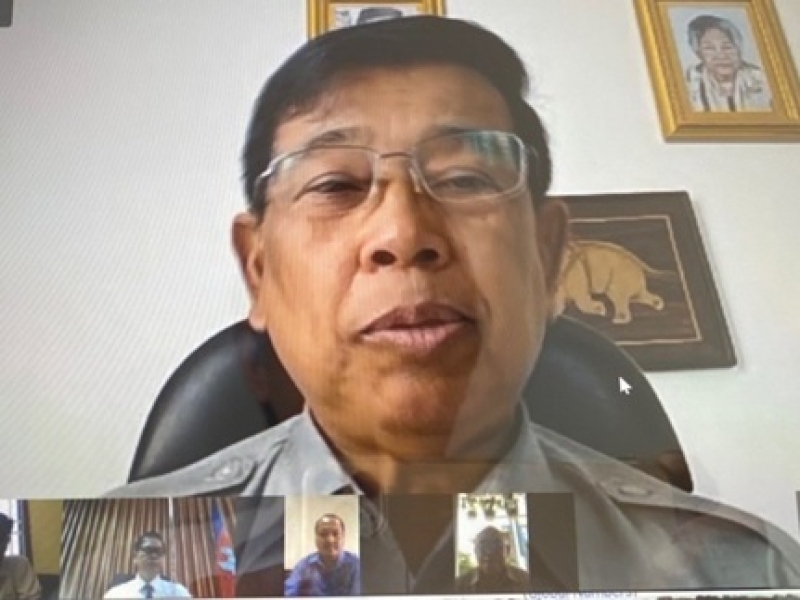
May 2020 Video Conference Meeting Held Under High Chairmanship of Senior Minister His Excellency Ieng Mouly
Senior Minister His Excellency Ieng Mouly, Chair of the National AIDS Authority, led a BlueJeans video conference meeting on the morning of Thursday, May 28, 2020. The meeting--attended by 48 Excellencies, Lok Chumteavs, ladies, and gentlemen, the vice chairs, secretary general, director of cabinet, deputy directors of cabinet, technical advisers, deputy secretaries general, department directors, deputy department directors, office chiefs, and deputy office chiefs--was to review the results of the work activities performed by the authority’s top managers and officials.
To kick off the meeting, His Excellency the Senior Minister welcomed and praised all the public servants for their active works with fine results. Along with this, he advised them to exert efforts for the institution’s progress, and he mentioned that this session of the meeting was the last video conference meeting, for we could possibly hold the next meeting together.
His Excellency the Senior Minister then permitted Secretary General HE Chhim Khindareth to present a report on the results of the work activities attained by the NAA’S top managers and Secretariat General in the response to HIV/AIDS in May 2020 and on the targets set for next month.
Secretary General HE Chhim Khindareth then made the presentation of the important points as follows:
• HE Tia Phalla has decided that less than 20 members are permitted to attend the NAA’s meetings to hold discussions with the aim of achieving goals.
• For FRA, the NAA has obtained, though HE Tia Phalla, three-year funding with an increase of $334,000 for work implementation from 2021 to 2023.
• As regards Co-Financing for ARV, there are US$11 million in the Global Fund’s three-year plan--with the first year (2021) consisting of US$2.5 million, the second year (2022) US$3.5 million, and the third year (2023) US$5 million--and three-year government budget of US$3.2 million requested by His Excellency the Senior Minister. It is US$14.2 in total.
• The related documents and orientation training sessions for integrating AIDS program into the development plan and the preparation of the budget plan for communes in Basedth District have been in completion.
• The draft of HIV/AIDS-related acronyms has been finalized.
• The draft of the guideline on HIV pandemic prevention has been finalized.
• The document of the 5th National Strategic Multisectoral Response to HIV/AIDS 2019-2025 has already been translated into the national language.
• It has been agreed on the initiative to further study the conditions and concepts of response to HIV/AIDS 2019-2025, based on documents such as: Smart 2019, NCHADS 2021-2025, Co-Financing, GF 2021-2023, AEM 2019, and APS 2019 as well as NASA financing study. Those papers require the Secretariat General to make diligent reading in order to seek common understanding to combine the components together.
Moreover, the Secretary General gave an account of the problems and challenges concerning the COVID-19 situation, which has affected the implementation of the following tasks:
• Due to the direct impact of COVID-19, some programs have not been able to be implemented.
• Cash payment to the fund has been delayed.
• No circular pertaining to annual budget preparation has yet been issued.
• No definite date for the 1st Plenary Session 2020 has yet been set.
• The 50% cut-down in the 2020 budget requires adjusting some activities and expenses.
• Some Global Fund activity programs, especially meeting and gathering activities, remain unable to be carried out.
• The ID-Poor card has so far been issued by only 20%, compared to the Royal Government and stakeholders’ 80% Joint Monitoring Indicator.
• Report have already been presented, through HE Tia Phalla, to the leadership on the meeting held with the Ministry of Planning, NCHADS, UNAIDS, and HP+. It was agreed that equitable cards be offered to HIV carriers and that health facilities are required to revamp software for equitable card registration. Nonetheless, thus far no response has yet been obtained from the Ministry of Planning. At this point, according to new figures, the number of high-risk population has risen higher. It was requested previously that the population, too, be provided with the equitable card (ID-Poor) like HIV carriers. Notification S.C.N. 213 does not specify the high-risk population, but civil society raised this issue in past meetings.
• It is estimated that the funding needed for the response to HIV/AIDS in the health sector (HSSP-HIV 2021-2025) is much different than the need of funding for the multisectoral response to HIV/AIDS (NSP V 2019-2023), although the NAA has carried its task in both fields: heath and non-health sectors.
• Funding gap for the response to HIV/AIDS strategy remains a cause for concern.
After listening to the report, His Excellency the Senior Minister thanked the Secretary General for the detailed account, saying, despite being under the pressure of risk posed by COVID-19, the NAA, specifically the Secretary General, is still able to perform well.
Afterwards, His Excellency the Senior Minister permitted NAA Vice-Chair HE Tia Phalla to make presentation of technical works. With the permission, HE Tia Phalla reported to the meeting as follows:
• With respect to the Secretary General’s presentation, HE Tia Phalla requested recommendation from His Excellency the Senior Minister on how to organize training to integrate the AIDS issue into the commune/sangkat development and investment plans (CDP/CIP).
• This year, we feel gratified because the Proposal for Global Fund is reflective of what we need. However, some officials’ knowledge is still limited in how to strengthen our institution, such as CDP and ID-Poor, and carry out implementation process.
• All stakeholders are content with the NAA’s major tasks performance.
• His Excellency the Secretary General has made presentation on a raft of activities. However, it should be understood which one is important. The most important point is that we should be aware of battlefields where the outreach workers have visited and met 150,000 or 170,000 patients that His Excellency the Secretary General has mentioned. Have we already visited them? What is the formula they have used? What are the tools? What has been done? What are the obstacles encountered?
• As for the ART sites, have we already clearly looked at them?
• Newest ordnance should be identified. Previously, STD, condom had spots was available, but now in the CCC’s and USAID’s presentations, there are about more than 10 types of ordnance, such as PrEP, PEP, Recency testing, PNTT, and EACMI. Are we already aware of them? Therefore, responsible officials at each department or Secretariat General should be assigned to look to catch up with medical mechanisms. If that is taken into consideration, we are up to 10 years behind them. As such, since we are in the dark about what they have done, we have to learn to understand and act together.
• NAA officials have to be well informed of all the networks operating in provinces and the (outreach workers) working team. Therefore, we need to know them all from the national down to sub national levels. Whenever we visit an area, we should manage to get grip on problems. We are now not that knowledgeable due to our failure to participate fully.
• For future strategy, we have to be familiarized with battlefields, ordnance, and networks of working teams. We should comprehend whether methodologies to be used to work with them are effective and whether we are able to encourage commune/sangkat chiefs to carry out this task. There are three points: 1) Crossing M&E, 2) Experience, and 3) Emersion, which means that previously they were careless and felt no pity for HIV carriers, but now they know how to change their behavior.
• In a number of workshop sessions, we cannot be trainers forever. That is, we can go there to listen, because we have not yet studied and understood some areas.
• It should be mentioned that in the future, from the national to subnational, provincial, and community levels, the tracking of patients from one to another would be performed in chain, with compassion, love, and conviction.
After receiving the detailed report on the combating strategy made by HE Tia Phalla, His Excellency the Senior Minister said we should comprehend and be aware of the tasks to be carried out in future, especially we should be familiarized with battlefields and ordnance. Besides, before responding to the reports presented by HE Tia Phalla and HE Chhim Khindareth respectively, he drew attention to the COVID-19 situation. This disease broke out without any scientists seeing it. It is a problem, like AIDS, that occurred due to the world’s negligence, despite advice offered by thoughtful people:
• Bill Gates mentioned the world’s disaster was not nuclear, but pandemic, epidemic. He has spent huge amount of money on the research into diseases taking place around the world.
• Some leaders, too, are concerned about COVID-19. Barrack Obama offered information prior to handing over his post that there would be pandemic problem, based on experiences in Ebola epidemic and so forth. He asked that vigilance be taken against pandemic, but he did not specify the year when it would materialize.
• During his term, Barrack Obama set up a unit within the National Security Council to deal with only the pandemic problem. However, after Donald Trump took office, he abolished everything, causing the economic and public health sectors to be affected until now.
• Apropos this COVID-19 problem, we have witnessed that the situation has eased a lot. The world has opened up for travel, allowing a slew of people to get in and out. However, it has not yet returned to the former status. It is still concerned, as vaccine has not yet been produced and drugs have not yet been actually discovered. This COVID-19 has brought about a raft of problems. Every country has faced severe budget deficits and serious economic crisis. Economically developed countries have not yet recovered. Only China has picked up, because it has managed to contain the disease successfully. It is able to resume operations now. However, in the wake of COVID-19, the world will rely on China. They might have to move factories and logistic networks provided by China to other countries. This being the case, they might invest in ASEAN (Vietnam). Anyway, over the past few months, the United States announced that it would transfer its China-based factories to America, but thus far, no factory has yet been relocated. The majority of factories in China are American-owned. If they were moved from China to the United States, production costs would go up, and they might lose Chinese markets as well.
Cambodia, like other countries, has suffered economic and public welfare impacts as well as threat to social development. The Royal Government has introduced successive measures to stabilize affected business activities with a view to helping alleviate the livelihood of Cambodian workers, employees, and citizens. At present, our factories are still operating, and it is hoped that our Cambodia will not be gravely affected, because we are able to switch garment factory jobs to any other employments. If workers are unemployed, the Royal Government will provide them each with at least $70. Besides, they could as well help their parents with works at their home villages.
Moreover, the disease has led to changes in people’s lifestyles, such as hygiene in washing hands with soaps and alcohol, and spurred them to become aware of keeping distance from each other. The disease has also caused encumbrance to some of our works, but so far, we have been still able to operate almost as usual. We wait for June. If the situation remains fine, we will then be able to operate again in July.
• As regards the Global Fund’s missions and activities that the Secretary General mentioned, we have been able to carry out only 46%. Anyway, if the situation keeps going on this way, we should look for other various ways, such as stepping up visits, but scaling down the number of officials.
• Moreover, concerning our plenary session that we expect in June, if the situation further improves, we can begin it somewhere in mid-July. However, if it is still unfavorable, we will hold a video conference meeting in early July as usual.
• The different assessments between the costs of AIDS and non-AIDS works are unalterable.
• We take Kampong Speu as target province for integrating the AIDS work program into the subnational level. However, we start first with Basedth District and then the entire province.
• The action plan advised by HE Tia Phalla should be implemented stage by stage, not overstepping any points. Moreover, we should especially know the battlefield, but we should not go there directly, for we are coordinator of AIDS work. Those who go there directly are ART site treatment providers. We should be aware of this.
• There should be solutions found through mutual learning, teaching, and explaining. HE Tia Phalla advised His Excellency the Secretary General to have his officials learn and comprehend about battlefield and ordnance.
• His Excellency the Secretary General should prepare a letter, advising the provincial governor that the NAA will use Kampong Speu Province as a region for implementing national policies and AIDS program at subnational level.
• NAA officials, from department deputy directors, should build their capacity through undertaking training courses in order to take part in offering advice on our policies.
• HE Tia Phalla, who is most skilled, should help provide instruction with a view to stepping up knowledge of all the NAA officials and sharing experiences with them.
• Prior to program implementation, there was no interaction between the NAA and nongovernmental organizations. Therefore, to maintain long-term sustainability, as work coordinator and national policy executor, we should be cognizant of everything that nongovernmental organizations are doing. Sometimes, the commune/sangkat level is more knowledgeable. Whenever we work with nongovernmental organizations and subnational and commune/sangkat officials, we should only think that we are in search for understanding. We should use any methods to motivate them to provide us with more information. We should also advise them to effect implementation in line with national policies.
Once again, His Excellency the Senior Minister permitted HE Tia Phalla and HE Chhim Khindareth to voice more views:
HE Tia Phalla informed His Excellency the Senior Minister that the Buddhism for Health organization has already worked in 150 communes/sangkats throughout the country. Despite its meager budget, the 150 communes/sangkats still can have their shares. That being the case, the Secretary General should prepare points 1, 2, and 3 for subsequent implementation.
His Excellency Chhim Khindareth informed His Excellency the Senior Minister that now the Secretariat General has had new development and formulated new modalities. That is, everything should be done with one voice, there should be understanding and solidarity, and all problems should be raised at meetings and then presented for the high decision of His Excellency the Senior Minister. In general, the Secretariat General has constantly sent two department directors or deputy directors to conduct study with HE Tia Phalla. Upon their return, they should provide information reports to all the officials at technical meetings. In addition, at every meeting of the Technical Advisory Council, each organization should present surveys it has conducted. Regarding officials accompanying the top manager, it is most important for them to learn while working to collect information for dissemination at the Secretariat General.
At the end, His Excellency the Senior Minister advised HE Tia Phalla that, while being on mission, he should be accompanied by the Secretariat General’s officials, that after returning, he should share his knowledge and experiences, and that if shortcomings are discovered, he should seek ways to complement them. All of our top managers, from deputy department directors up, should grasp our policies and technical works and be able to substitute for each other.
The meeting concluded at 11:15 am in a most pleasant and cordial atmosphere.







 info@naaa.gov.kh
 +855 (0)23 885 129
 +855 (0)23 885 279
 ភាសាខ្មែរ
 English