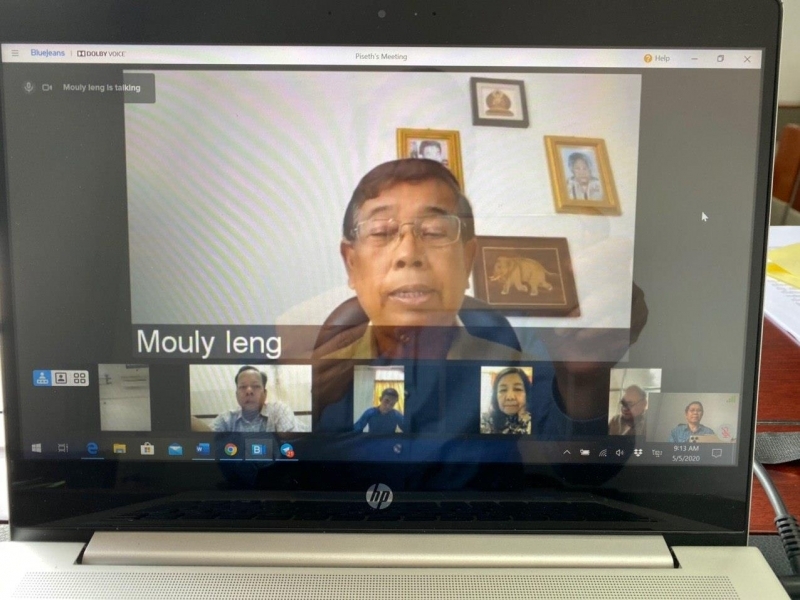
BlueJeans Video Conference Meeting Held Under High Presidency of Senior Minister His Excellency Ieng Mouly
Senior Minister His Excellency Ieng Mouly, Chair of the National AIDS Authority, led, on the morning of May 5, 2020, a BlueJeans video conference meeting, with 54 Excellencies, Lok Chumteavs, ladies, and gentlemen, the vice chairs, secretary general, director of cabinet, deputy directors of cabinet, technical advisers, deputy secretaries general, department directors, deputy department directors, office chiefs, deputy office chiefs. The purpose of the meeting was to review the results of activities undertaken by top managers and converse with them and NAA officials.
At the beginning of his remarks, His Excellency the Senior Minister commended all the public servants for their active works with fine results. Moreover, he advised that they carry on with their efforts to achieve the institution’s growth and gain the leadership’s trust. He then permitted Secretary General HE Chhim Khindareth to present a progress report on the results of the work activities carried out by NAA top managers and Secretariat General in response to HIV/AIDS as well as improvement, obstacles, and challenges taking place in April 2020 and on the targets set for the subsequent month.
HE Chhim Khindareth then gave an account of the obstacles and challenges to the meeting as follows:
·Due to the COVID-19-related situation having not yet showed signs of abating, the implementation of some works has been put off. Especially, the implementation of the Global Fund’s project relating to the gathering for training sessions has not yet taken place, thereby limiting funding costs.
·As regards the circular on the preparation of the strategic budgetary plan 2021-2023, it has not yet been received, hence the Secretariat General still lacks basis for budget preparation.
· For the implementation of the budgetary plan 2020, due to the COVID-19 problem, the Ministry of Economy and Finance has issued two guidance circulars. First, Letter No. 001 on regulating and strengthening financial laws and second, Letter No. 003 on managing public finance from expansion budget to high austerity budget with a 50% cutback in 2020. The purpose of the reduction consisting of four priorities: 1) to fight against COVID-19, 2) to maintain the stability of the people’s minimum living standard, preventing them, especially the poor and jobless, from starvation, 3) to try to do utmost to enable businesses to survive as well as to preserve jobs and especially economic aid, and 4) to maintain peace, public order, and social stability. This includes the 50% reduction in office supplies; furniture; information technology equipment; non-information materials; costs for domestic and overseas trainings, meetings, workshops, conferences, propaganda, and information dissemination.
·The NAA still has a chance, for the 50% reduction of domestic missions does not apply to three ministries. That is, the Ministry of Health (National AIDS Authority), the Ministry of National Defense, and the Ministry of Interior’s Public Security.
·Implementing Notification S.C.N 213, we have already undertaken a number of works. However, some other works have not yet established proper mechanisms, such as the first, second, and third measures.
·First Measure:
.The Secretariat General has prepared a draft concept on the integration of AIDS program into the development plan of communes in Kampong Speu Province’s Basedth District.
.The Secretariat General continues to organize simple, easy to understand, and accessible training programs for commune chiefs, members of commune councils, committees on women and children affairs, and police stations.
.From concrete experiences, some communes in Battambang, Kampong Cham, and Kandal Province have provided commune/sangkat budget fund for HIV carriers to travel to get ARV and offered cash for patient caregivers as well (5,000 riels per day offered in Kampong Cham Province’s communes).
·Second Measure:
.The issuance of ID-Poor for HIV carriers has thus far been only 20%, compared to 80% of the government and partners’ joint indicators (JMI). This is due to: 1) the problem of preserving confidentiality in compliance with Article 33 of AIDS Law, and 2) the existing system only applies to the poor according to established criteria.
.In consultations among NAA, MOP, NCHADS, UNAIDS, and HP+, it has been agreed that in order to attain achievements according to the set criteria:
.1) The ID-Poor should be issued for carriers at the ART sites where health officials are responsible. In this case, the Ministry of Planning will negotiate with GIZ to adjust the current registration system so that it will be operational. To have this operate, funding is needed to adjust the registration system and train responsible health officials.
.2) For the families of poor carriers, they should apply for ID-Poor according to the procedures that the Ministry of Planning conducts every three years. In this case, the carriers are able to ask that their poor families apply for ID-Poor in conformity with the Ministry of Planning’s procedures.
·Third Measure:
The funds that local health facilities have received consist of: 1) annual state counterpart budget and 2) budget contained in the Cambodian Health Equity and Quality Improvement Project.
The Health Equity and Quality Improvement Project consists of:
.Health Equity Funds (HEFs) for the poor.
Service Delivery Funds (SDGs): 1) Performance-based payment; 2) Lump-sum grants announced by the Ministry of Economy and Finance and the Ministry of Health; 3) User fees, and 4) National Social Security Fund (NSSF).
·With respect to Notification S.C.N 213, HE Professor Eng Huot, secretary of state of the Ministry of Health, has agreed with the verbal conversation with HE Tia Phalla on the use of the above-mentioned local health funds to carry out activities in response to HIV/AIDS at referral hospitals and health centers.
·The NAA should present an official letter to the Ministry of Health about the preparation of measures and procedures for the provision of funds to be utilized by operational referral hospitals and health centers to respond to HIV/AIDS and forward a copy of the letter to the Ministry of Economy and Finance and Ministry of Interior.
·At present, the capital city and provincial health offices are under the authority of capital city and provincial administrations in terms of services, staffing, and budgets. Moreover, the capital city and provincial governors are mandated managers and chairs of AIDS commissions, with a wide range of possibilities to manage the health offices’ budgets and activities as well as with the capability to orient commune/sangkat funds to respond sustainably to HIV/AIDS for the sub-national level.
After listening to the report, His Excellency the Senior Minister praised the Secretariat General for its presentation of the report and elaboration. Therefore, we should continue to work further in line with our programs. Indeed, while being unable to conduct missions due to COVID-19, we have to develop training projects that we all should know. Integrating HIV works into the activities of other ministries and institutions, we, as technicians, should understand what each ministry and each institution should do. We need to pick a ministry or an institution for discussion to find out what kind of works it should perform. For instance, what the Red Cross should do? We may also ask them to make video clips for disseminating information on infection prevention. This our internal work to come together. The tasks to be carried out are first referring to national strategy and second the notification containing six measures. We have to undertake some of the works with provincial governors, provincial levels, because they are managers of their provinces, and we have seen that the notification has paved the way for the sub-national level to follow the Royal Government’s policies. Hence, in some areas, there is no need to provide further guidance. The notification’s guidance is already sufficient for implementation.
We have concrete results with which HE Tia Phalla will explain the available budget. However, it is unknown how to spend it, from which figure. Now, we are ready to teach communes/sangkats, health centers, or provincial health offices to understand that the existing budget can be used for AIDS work. We have to take the opportunity when we are still unable to undertake missions to perform those tasks. We look geographically at the concrete work of fighting against AIDS at each ministry and each province, aiming at the areas we call hot spots where the most serious AIDS problem takes place.
Afterwards, His Excellency the Senior Minister permitted NAA Vice-Chair HE Tia Phalla to explain the works that were concretely observed in localities. With the permission, HE Tia Phalla then reported to the meeting as follows:
oLast month, we presented a proposal to request budget from the Global Fund and coordinated the work to be implemented pertaining to health facility of the Notification S.C.N 213.
oA letter should be prepared to request the Ministry of Health to issue an official letter to enable us to implement the third notification everywhere.
oAs regards the second notification, it is to locate poor HIV-carrier families for HE Kev Ou-ly to look at the possibilities to adjust software to identify poor families. He will carry on with this task by holding consultation with GIZ to finalize the software system.
oFor the commune/sangkat plan, we have held discussions with His Excellency the Secretary General. We have written a concept note and made orientation, and we will start the internal training process. Afterwards, we will visit localities where we will split according to the areas of responsibility to check the account codes at provincial treasuries in line with provincial plans and then we will invite provincial governors, deputy provincial governors, and provincial treasuries to integrate them into the commune/sangkat plan with joint concurrence. This is what we deal with the notification.
oWe will check some remaining works with HP+ so as the latter will assist us until December. We will then look at what is still left to allow LINKAGE 360 to succeed HP+ so that we will continue working with it on the commune/sangkat issue and so forth.
oThe World Health Organization has provided feedback with comment praising us for our consideration given to sustainability. It has also mentioned the Notification S.C.N 213 as well. This constitutes our pride.
oMaintaining sustainability in the three visited provinces, I found that Battambang Province was strongly encouraging, with three communes having integrated the AIDS work into the commune/sangkat plan. Moreover, the more important locality was Tuol Ta-ek commune, which had up to US$2,000 in communal budget. A meeting was held with the participation of the commune and sangkat chiefs and provincial AIDS committee where 15 kg of milled rice, 60,000 riels in cash, and soy sauce were offered to each of the 30 of the 54 patients. As for Roka and Bansay Krek communes, they also have budget for AIDS work. However, Buddhism for Health backs them. It is the organization, which takes the initiative on the issue regarding the poor, the old, and the disabled by linking tuberculosis to AIDS.
oHelping provide rations in communities is a must. For instance, according to observation, searchers for patients need to travel up to 120km, but they do not use health centers in their search. As the health centers do not accompany them, civil society organizations are in the unknown. Therefore, they travel up to 120km, 70km, 40km through the jungle and mountain.
oIn Banteay Meanchey Province, there are lost to follow-up. We have observed that only a small number of patients has returned to receive services at health centers.
After listening to the report presented by HE Tia Phalla on his visit to Battambang and Banteay Meanchey Provinces, His Excellency the Senior Minister made the following notes:
·The integration of AIDS program into the sub-national level and especially into the provincial level has been implemented gradually. This work depends on the provincial AIDS committee. If it carries out the task, there can be some results.
·Regarding the Red Book (about the guidance on the undertaking of commune/sangkat social service activities), we have to make copies for distribution for all of us to learn prior to completing our works. AIDS work needs to spend budget at an allowable figure.
·As the Global Fund has set out the indicators for us to achieve, we have to continue doing whatever we are currently performing in the sense of strengthening the sustainability of the National AIDS-Combating Program.
·Be mindful of our internal affairs while the COVID-19 pandemic is invading and while we are unable to go anywhere to conduct our mission. Activities should be charted as follows: 1) what we intend to do? 2) what are the tasks? and 3) who should be collaborated with?
·Integrate the AIDS program into the works of institutions, departments, and ministries in conformity with the Notification.
·The Red Book is the guideline from the Ministry of Interior. It should be known which figure of budget that provinces can withdraw for communes to use to respond to HIV/AIDS. It is that we start working with provincial governors, provincial finance offices. So, we should be clearly aware of everything. That is:
1) to integrate the AIDS program into the work activities of ministries, offices, institutions, national level, and sub-national level.
2) to offer the NAA guidance to the ministries, offices, institutions, national level, and sub-national level on AIDS work according to the roles of respective ministries, offices, and institutions.
3) to encourage the ministries, offices, institutions, national level, and sub-national level to present proposals to request national budget.
4) to assist in checking the implementation of action plans.
·While the COVID-19 pandemic is invading, we join hands to prepare plans, organize opening internal training sessions for us all. The COVID-19 has not yet showed sign of abating. The Ministry of Health states that we are still in yellow light. However, if there is no new case detected within 14 days, we can resume our travels. Anyway, impacts in our Cambodia are not as severe as in the other countries. Our economy has not been shut down completely. Now, some people no longer wear masks. However, we should not be negligent, but remain vigilant. If compared with other countries, we are very much relieved. Nonetheless, since COVID-19 has not yet showed sign of declining, our missions remain restricted.
·In the Red Book, there is a sample called Social Contract. Therefore, communes can hire any official, any civil society organization, or any private company to assist them in performing social works there.
·We want the network of AIDS carriers to join us in our work. If they sign up, we should look for a network in that community by selecting its representative to work in commune/sangkat in order to assist in searching for HIV carriers to be aware whether they have already received drugs and taken drugs regularly, if they are still able to get drugs, how many months the drugs received will last, and whether they have means to travel to the local health facilities (some villages have funds to send patients to receive medicine). The Secretary General should conduct study in consultation with HE Tea Phalla and HE Ros Seilavath, according to their respective technical skills.
·Concerning social services in communes/sangkats, what can they do? There were meetings about social issues taking place in villages regarding the dead, the old, and widows. Now, as we have a technical forum, each topic should be selected for study.
·The key task is to integrate activities into the sub-national level that we have to undertake successfully. This is the task of maintaining sustainability of the AIDS program.
·The budget at the sub-national level can as well be used to deal with AIDS, tuberculosis, malaria, domestic violence, human trafficking, and drugs use. All these problems should be used to teach commune/sangkat chiefs to understand.
Before concluding, His Excellency the Senior Minister advised that our work is to conduct strategic study in order to protect the people from new AIDS infection.
·Our preventive program has extended and covered human rights, communities, and gender for detailed study to compile into concept for mutual training while working directly with the sub-national level. Moreover, one should behave most simply to make certain that one is capable of working with commune and village chiefs.
·Commune/sangkat chiefs should be taught how to gather HIV carriers to choose their networks or real representatives in communities to work with the commune/sangkat levels.
·We, especially the Secretariat General, should undertake detailed studies by requesting advice from the Excellencies and Lok Chumteavs, the experienced members, as input to formulate the concept note.
·We have to follow the three basic principles: 1) National AIDS-Combating Strategy, 2) Notification S.C.N as the Royal Government’s policy, and 3) the Global Fund program. Therefore, His Excellency the Secretary General should draft a study project beforehand with Their Excellencies the Deputy Secretaries General, while we are still unable to undertake mission.
·Their Excellencies Tia Phalla and Ros Seilavath are asked to offer comments on the three issues: 1) what are the impacts on our AIDS program that we implement during COVID-19 pandemic? 2) what are challenges? 3) What is needed to be selected as priority?
·HE Tia Phalla contacts the CCC in accordance with the National Malaria-Combating Program and Health Strengthening System.
His Excellency the Senior Minister mentioned that his mandate as member of the GF Board Member for the Western Pacific Region Constituency will terminate by the end of the coming June. Before the end of his term, he will present his views on the AIDS issue to the Global Fund, which will hold its meeting on 14-15 May. Therefore, he will have more opportunity than before in our AIDS work.
As regards reports, His Excellency the Senior Minister will hand them over to the Cabinet to detail his programs in last April. Meeting will be held at least twice a week.







 info@naaa.gov.kh
 +855 (0)23 885 129
 +855 (0)23 885 279
 ភាសាខ្មែរ
 English