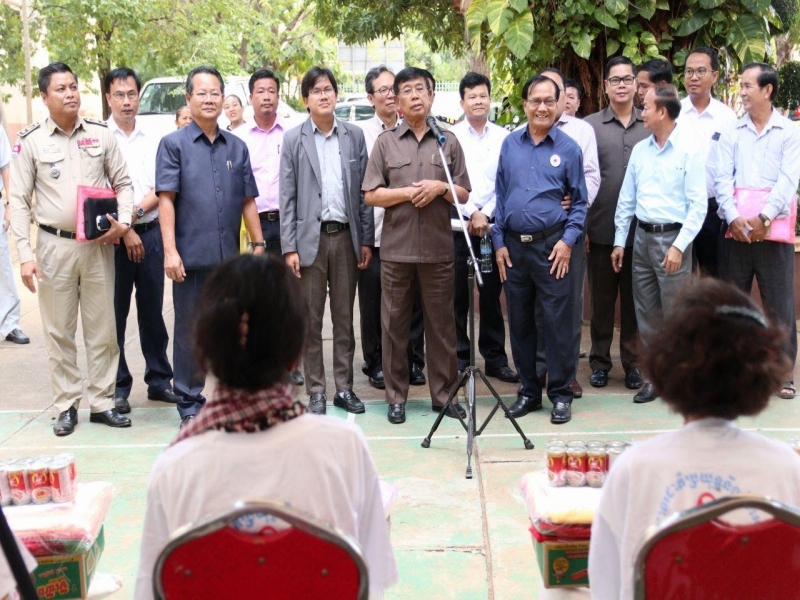
H.E. Senior Minister Ieng Mouly: “Samdech Techo Hun Sen Calls for Turning Fight Against AIDS Into National Trend”
(Kampong Cham): Senior Minister Ieng Mouly, Chair of the National AIDS Authority, has stated at the workshop on the multisectoral response to HIV/AIDS held by Kampong Cham Province’s AIDS Committee in the second half of 2019 that Samdech Techo Hun Sen has called for turning the fight against AIDS into a national trend, while we are concerned over the rising tendency of new infections.
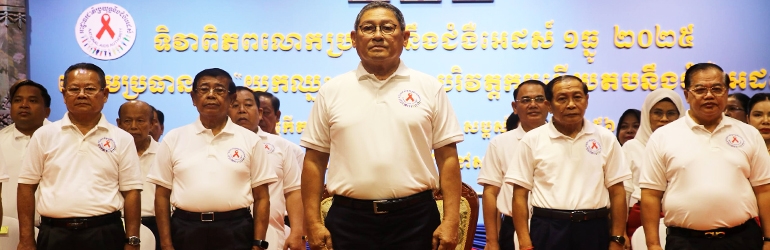
H.E. Senior Minister Ieng Mouly made the remarks at the workshop on the multisectoral response to HIV/AIDS, taking place at the province’s health office on August 15, 2019, which was attended by over 50 participants consisting of leading managers of the National AIDS Authority; Han Kosal, deputy governor and vice chair of the province’s AIDS Committee; Dr. Kimsuor Phirun, head of the provincial AIDS Secretariat and health office; representatives of the province’s AIDS Secretariat, relevant offices, civil society organizations (AHF, MHC, KWWA, CWPD, PSOD and Spien); local authorities, and armed forces members.
The workshop was held to review the progress in and conduct study to seek understanding of the multisectoral fight against AIDS at the subnational level, through incorporating the AIDS-fighting work in the Safe Village and Commune Policy towards achieving the 95-95-95 targets by 2025.
Following the welcoming speech presented by Kampong Cham Province’s deputy governor Han Kosal, the Senior Minister stated that Samdech Techo has called for turning the fight against HIV/AIDS into a national trend. We are concerned over the rising tendency of new infections. According to predetermined target, there is an increase of new infections among gay young people due to their unprotected sex practice and the technological advancement in telephone communication.
The Senior Minister informed the workshop that Cambodia has been recognized by the UNAIDS for having achieved the 90-90-90 targets since 2017. While we have succeeded in combating AIDS, assistance from development partners has been in downward trend. This being the case, the National AIDS Authority is in the process of considering the sustainability of the fight against AIDS by joining forces to carry out multisectoral prevention.
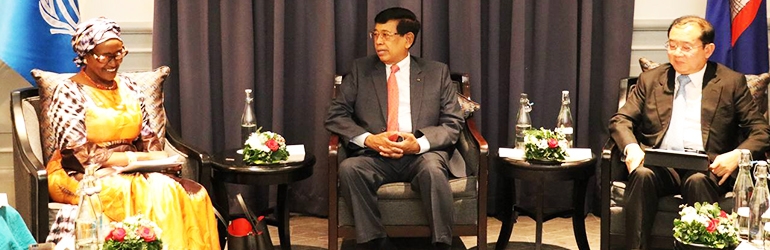
Of late, Samdech Kittiprittbandit Bun Rany Hun Sen permitted the UNAIDS president to meet to discuss assistance for AIDS patients. Therefore, once we do not receive outside aid, we will be able to ensure AIDS prevention and provide the patient with treatment and care.
There are now two persons infected with HIV each day and over 2,000 deaths each year.
We will drop the AIDS-combating job to communes and sangkats. Along with this, relevant ministries, institutions, and offices involved in the prevention, are asked, while meeting people and students, to include talk about drugs and road traffic issues in AIDS program as well. We join hands to prevent AIDS through interfaith education. The offices of youth education and sports and vocational training may join by means of educating the youth, students, and workers about the prevention.
Regarding HIV infection, the Senior Minister said that, for the new infected people, we should conduct study to find out whether they are recent or long-term cases. If there were more recently infected people, it is a cause of concern for us. Besides, he asked that the AIDS Committee timely present comprehensive reports and use creativeness to formulate solutions to the AIDS problem.
Dr. Kimsuor Phirun, head of Kampong Cham Province’s AIDS Secretariat, made a presentation of the response to HIV in his area. He also informed of the progress in the fight against AIDS and resolved to successfully prevent HIV/AIDS to be ranked first as in the provision of health services.
Afterward, Dr. Tea Phalla, Dr. Ruos Selvat, and Dr. Teng Kunthi gave presentations of the rise in the HIV infection rate among men who have sex with men. They also asked about the rate of providing services and new infections, and they called for multisectoral participation in the fight against AIDS, because at present, there is a lack of multisectoral involvement and report presentation.
At the end, the Senior Minister made a two-point recommendation as follows:
1. We keep carrying out the work in the health sector (blood test, treatment, and care).
Concerning Pre-exposure Prophylaxis, PrEP (preventive drugs taken by high-risk people), it is asked that all hospitals closely collaborate. Additionally, study should also be undertaken on new infected people to find out the cause.
2. Since multisectoral works are too slow, relevant ministries and institutions should take part, starting from now, in performing them gradually. We will have sustainability later. We will also undertake study about programs to be implemented.







 info@naaa.gov.kh
 +855 (0)23 885 129
 +855 (0)23 885 279
 ភាសាខ្មែរ
 English