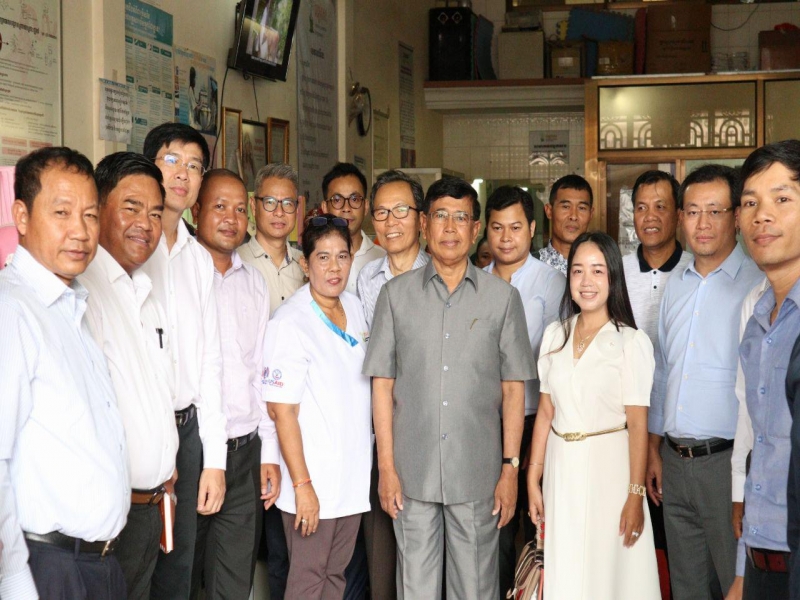
H.E. Senior Minister Ieng Mouly led Delegation of the Ministry of Econony and Finance, Secretariat General of the Council of National Social Protection and Ministry of Health to understand in place on Care and Treatment Service Provided to People Living With HIV
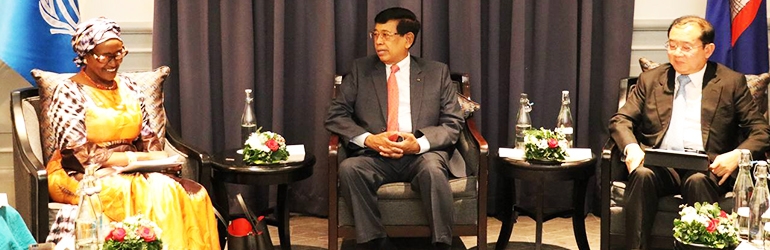
H.E. Senior Minister Ieng Mouly, Chair of the National AIDS Authority, personally led a delegation comprising of the National AIDS Authority, Ministry of Economy and Finance, Ministry of Health and Secretariat General of National Social Protection Council, to seek understanding about the care treatment service provided to the people living with HIV at Preah Sihanouk Hospital Center of Hope and Chhouk Sar Clinic on the morning of 7 August 2019.
The purpose of the specific fact-finding is part of the Royal Government’s efforts in conducting study to seek understanding of the concrete situation about the provision of care treatment services for and response to AIDS in order to better determine the target, objectives and goal of controling HIV transmission. The activities will help to better shape policy formulation and to heighten the quality of services to make them more efficacious and flexible in the concrete context. Self-responsibility and ownership for better health and need more effective resources and being more responsive to the present and future needs.
It should be recalled that in the Kingdom of Cambodia, the first case of HIV infection was detected through blood test in 1991, while the first AIDS patient diagnosed in 1993. Thus far, Cambodia has had roughly 60,000 people living with HIV who have received antiretroviral therapy at 68 hospitals and clinics nationwide. While Preah Sihanouk Hospital Center of Hope is currently providing treatment to some 3,775 HIV-infected patients, there are 1,200 patients receiving antiretroviral drugs from Chhouk Sar Clinic.
For a patient whose treatment results are improving, he/she has to have his or her health checked and to receive antiretroviral drugs at least once in three months. On average, about 60 to 70 patients come to get services at Preah Sihanouk Hospital Center of Hope each day. To date, the care treatment has been provided free of charge to those living with HIV. The antiretroviral drugs for the 60,000 patients are supplied by Global Fund, while a part of the expenses for the treatment is supported by the Royal Government budget contained in the Ministry of Health’s budget package, the other paid by international development partners.
At the time when funds offered by Global Fund and other overseas donors to the Kingdom of Cambodia have been gradually reduced, the Royal Government of Cambodia, with the National AIDS Authority, as policy coordinating institution, having joined hands with the Ministry of Health and other related entities to search for more new approaches to try to provide more effective HIV prevention services and care treatment with antiretroviral drugs, with a view to achieving the target of reducing HIV transmission to the lowest level by 2025.
Cambodia, based on estimate, may need roughly US$50 million in local financial resources for providing care treatment and responding to HIV over the next six years.








 info@naaa.gov.kh
 +855 (0)23 885 129
 +855 (0)23 885 279
 ភាសាខ្មែរ
 English