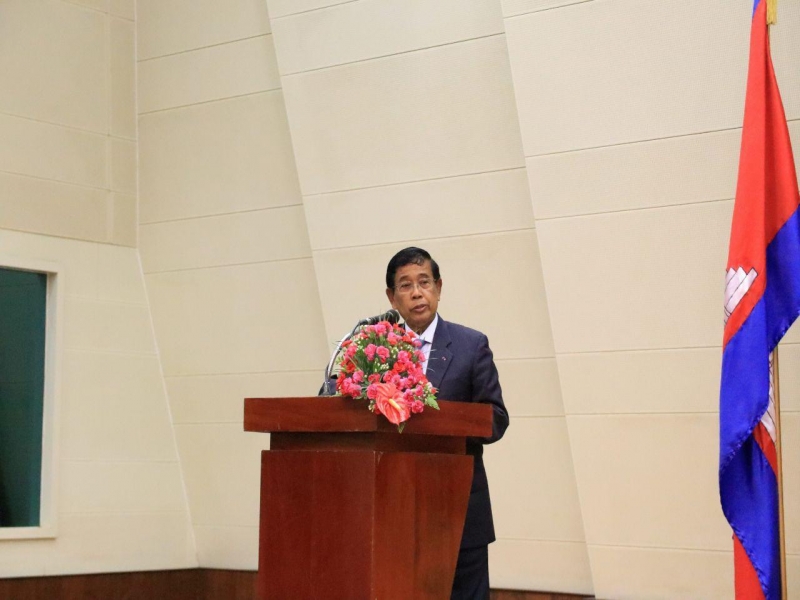
Senior Minister His Excellency Ieng Mouly Presides Over Celebration of 25 Year Achievement in Response to HIV Spread
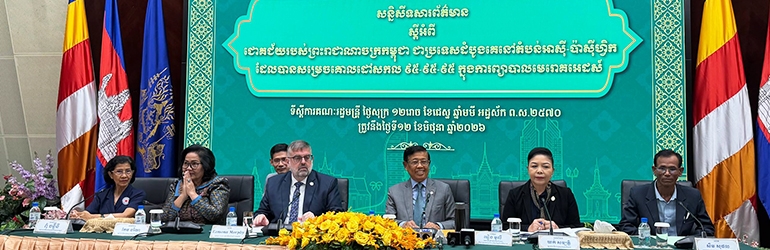
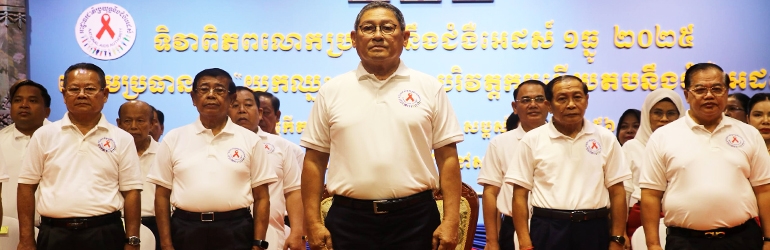
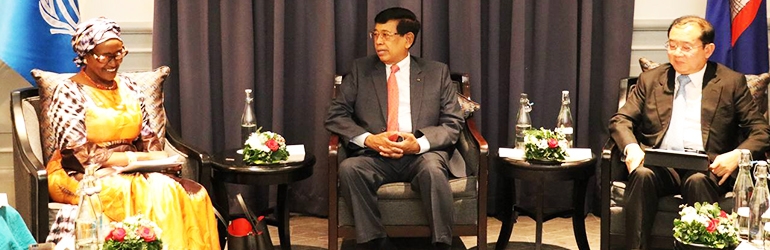
His Excellency Senior Minister Ieng Mouly, Chair of the National AIDS Authority; Their Excellencies, Lok Chumteavs, ladies, and gentlemen the leaders of ministries, national entities, and subnational administrations; ladies and gentlemen from development partners and domestic and international civil society organizations as well as ladies and gentlemen the former activists held a celebration of the 25 year achievement in response to HIV spread at the Office of the Council of Ministers on 6 June.
His Excellency the Senior Minister recalled that the first case of HIV was discovered in Cambodia in 1991, and two years later, 1993 was the time when the first case of AIDS was diagnosed. The subsequent years in the 1990s, load rates among sex workers were high and the rate of HIV transmission among the general population skyrocketed and spread very fast.The Cambodian people, getting infected with and carrying HIV, fell sick and died one after the other. It was a period when Cambodia experienced fear, shock and dramatic discrimination against AIDS patients. The ferocity of the spread of HIV and the lack of preventive knowledge and means as well as of treatment possibilities at that time caused our Cambodia to lose young workforce successively, leaving behind social crises, family breakups, orphans, and worrisome poverty.Fear and hesitancy to get closer to the patients, discrimination, scorn, and erroneous prejudgment about victims’ sexual behavior were rampant, posing tremendous impediments to the fight against this disease.
We still recall unfortunate AIDS patients who lost their lives daily at almost all the hospitals we visited. We still imagine the cremation of AIDS patients every day and the weeping regrets of the bereaved families and innocent orphans.
Over the last 26 years, Cambodia has developed from a country abounding with tragedies, deaths, and separations in the wake of the Khmer Rouge regime’s Democratic Kampuchea and civil war.
The development of preventive measures, discovery of medicine, and possibility of expanding the scope of high-speed therapy, as well as the strong political support of the Royal Government’s top leaders in adopting new technologies have enabled our Cambodia to reduce dozens of new infections occurring daily to just two or three contagions a day now.
The guidance, leadership, political support, and comprehensive strategy of Samdech Akka Moha Sena Padei Techo Hun Sen, Prime Minister of the Kingdom of Cambodia, and of Samdech Kittiprittbandit Bun Rany Hun Sen, President of the Cambodian Red Cross, have strengthened inter-sectoral cooperation in HIV spread response.
A study by UNAIDS shows that Cambodia is the most leading country in preventing people from HIV infection in the Asia-Pacific region, as over the past 26 years, we have protected 900,000 people from HIV transmission and saved 600,000 others from death due to AIDS.
Nonetheless, despite the impressive decline, the mortality rate of AIDS patients is still remarkably high, requiring more attention to enhancing treatment effectiveness. We still face myriad challenges, including financial resources for fighting AIDS that have further declined. Multisectoral response and integration of programs to combat and respond to HIV/AIDS must be continued in agreement with the Fifth National Strategic Plan 2019-2025 and in accordance with sustainable roadmap and successful efforts in the search for more new cases to be sent for antiretroviral treatment.
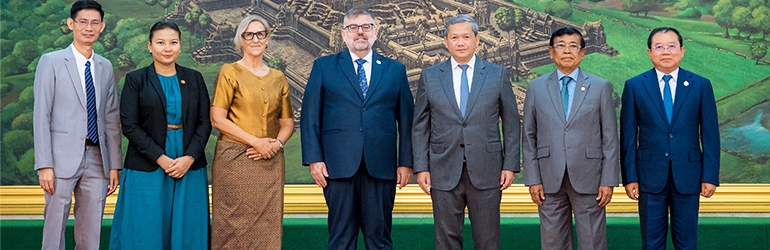
His Excellency the Senior Minister again expressed thanks and presented certificates of commendation to members of the National AIDS Authority, UNAIDS, development partners, Global Fund, domestic and international civil society organizations, artistes, HIV carriers network, and key population network for their active participation in acquiring proud achievements for Cambodia in the past.








 info@naaa.gov.kh
 +855 (0)23 885 129
 +855 (0)23 885 279
 ភាសាខ្មែរ
 English